Summary
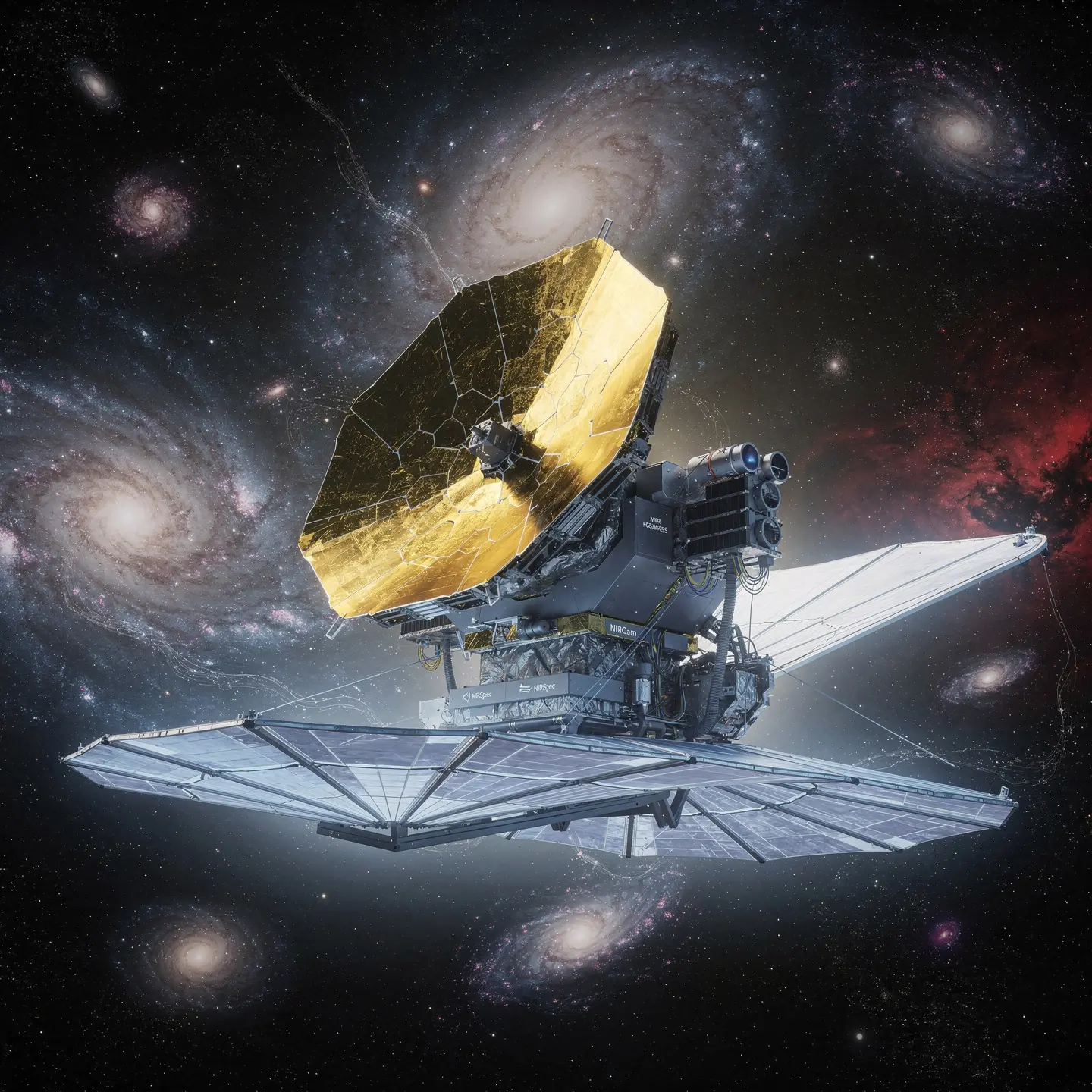
The James Webb Space Telescope is humanity’s premier infrared observatory, designed to peer back to the earliest galaxies, study stellar nurseries, and probe the atmospheres of distant exoplanets. A collaboration among NASA, ESA, and CSA, JWST launched on December 25, 2021, and orbits around the Sun–Earth L2 point. Its 6.5-meter segmented, gold-coated beryllium mirror and suite of instruments—NIRCam, NIRSpec, MIRI, and FGS/NIRISS—enable exceptionally sensitive infrared observations. By operating at cryogenic temperatures behind a five-layer sunshield, JWST can detect faint heat signatures from the first luminous objects, map star and planet formation in dusty regions, and analyze the chemical fingerprints in exoplanet atmospheres, reshaping our understanding of cosmic history and habitability.
Fun Facts
- JWST’s primary mirror is composed of 18 hexagonal segments that fold for launch and deploy in space.
- Its sunshield is roughly the size of a tennis court and blocks sunlight and heat, allowing ultra-cold operations.
- The MIRI instrument operates near 7 K (~-266 °C), colder than deep space, to see the faintest mid-infrared signals.
- NIRSpec uses a microshutter array with about 250,000 tiny controllable shutters to observe hundreds of targets at once.
- JWST’s first deep-field image, released in July 2022, revealed thousands of galaxies in a patch of sky smaller than a grain of sand at arm’s length.
- Initially known as the Next Generation Space Telescope (NGST), it was renamed in 2002.
Explore JWST’s latest images, data releases, and discoveries to see how it is transforming astronomy, from the first galaxies to nearby exoplanets. webb.nasa.gov